-
Homeschooling Myself

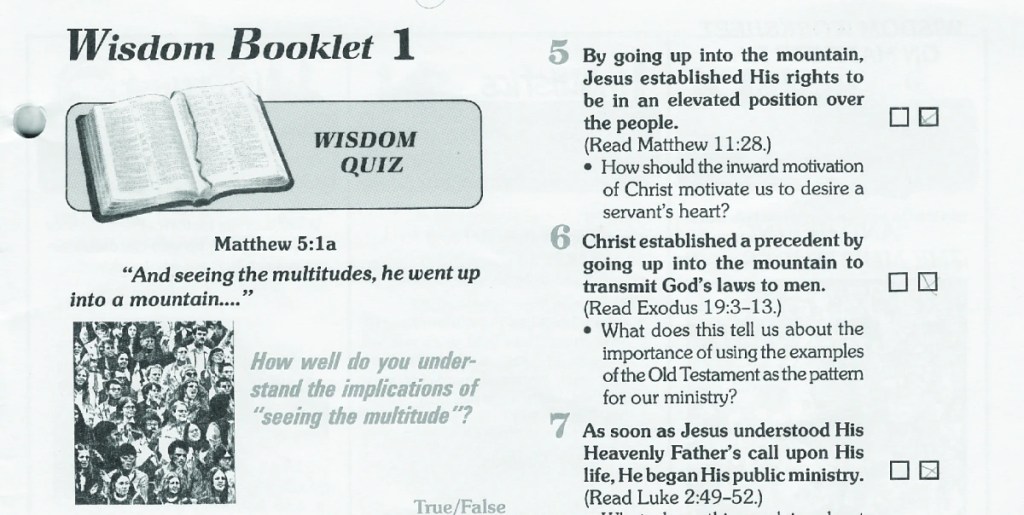
When I returned home from IBLP’s headquarters, the school year was starting and my responsibilities went from working a 9-5 job to starting 8th grade. My brothers and I were homeschooled by our parents, and though we joined competitive speech and debate clubs once I entered high school, we otherwise had very few extracurriculars and teachers. Each summer mom collected stacks of textbooks and each fall she’d hand them to us and say, “Here’s your customized curriculum!” My stack of books usually consisted of Saxon Math textbooks, biographies of important historic figures, creationist science textbooks, booklets on Language Arts by IBLP, and of course, IBLP’s Wisdom Booklets, which have sections for each school subject with an (often unhelpful) Biblical spin on everything.
For a couple years I attended a science class that met once a week at a friend’s house taught by her mom. I remember dissecting defrosted corpses of a worm, a fish, and a frog in her kitchen, and hating every pungent second. I had 3 peers in the class, and the stay-at-home-mom who was our teacher didn’t have a background in science, but it was still probably the most technical class I took up until I graduated.
I struggled the most in math. It’s hard to learn without being able to ask a book questions, and it’s really difficult to Google word-problems. My mom didn’t know how to help me, and my dad worked 10-12 hours a day and didn’t have the emotional bandwidth to teach when he got home from work. I begged for a math tutor, especially closer to high school graduation when I planned to take the SAT, but mom wasn’t willing to pay anyone more than $10 an hour to tutor me, which meant that anyone we found to help wasn’t professional. Mostly I did math on my own, and several years in a row I repeated the same book because I just couldn’t grasp pre-algebra.
I don’t remember ever learning geography, social studies, or reading history from a traditional textbook. I did like to read, and creative writing was a favorite pastime of mine, so, educationally speaking, those were my best subjects.
I felt very alone in my education. My brothers and I had limited accountability from our parents or any teachers we had, and never took any tests by which to measure our comprehension. In fact, the first test I ever took was the SAT. Because of this, I had no idea how grades worked, as grades were only discussed when mom sent quarterly report cards to the umbrella school we homeschooled beneath. The process was like this:
“How do you think you did on English this quarter?” Mom would ask, her fingers perched over the keyboard at her desk.
“I think I did alright,” I would tell her.
“Great! I’ll give you an E for Excellent,” and she’d type that in. “How do you think you did on math?”
“Honestly not very good. It’s really hard,” I’d tell her what she already knew. “I would give myself a U for Unsatisfactory.”
“Oh, well that’s not going to look good on your report. And I’m sure you’re doing better than you think. I’ll just put in a G for Good.” And she’d type that in and send it off. And just like that, math was going just fine for me…on paper.
We’d start our studies in the mornings and then were free to do what we wanted in the afternoons. All I’d have to do was say, “Okay mom, I finished everything for today,” and she’d say, “great!” and then I was free. Or at least as free as you can be at home with nowhere to go.
Does that mean that I always did my studies properly before telling mom I was finished? No. But the neglect of my schoolwork only lasted until I realized that if my parents weren’t keeping me accountable, then my education was in my own hands. I was probably 11 when this occurred to me. I went from seeing what I could get away with to worrying about what job I’d be able to get someday if I was never able to comprehend my books.
In high school Liam didn’t actually open his math book for months and my parents didn’t find out about it until he admitted it, probably after having an oh-shit realization similar to mine about the possibility of graduating illiterate.
It was never a matter of if we would graduate: I knew we would. It was easy to write “Excellent” on report cards. But I worried what would become of me if I didn’t have anything to show for my diploma.
A continuing education once I graduated wasn’t on my parents’ minds at all. In fact, when I told them I wanted to go to community college, they were disappointed. In their minds, my destiny was to get married, have kids, and be a stay-at-home mom to homeschool them. (Yes, homeschool them with my “superior” education.)
A huge element of my education starting around fifth grade was Wisdom Booklet class, consisting of 5-6 homeschool IBLP families banding together to educate through IBLP’s curriculum. Some of this I enjoyed, especially the social elements. The other girls were my age and we liked spending time together, although our interactions were heavily monitored. It was nice to be interacting with people of all ages, from everyone’s tiny young siblings to other moms and sometimes dads. Some of the moms exerted such authority during any interaction with them that they scared me. Others were warm toward me in motherly ways that I didn’t usually receive from my own mom.
The moms would split up the sections of each Wisdom Booklet and take turns teaching “classes” every week, sometimes assigning kids to teach sections too. It always stressed me out when I had to teach a section to everyone else because I felt like I had to be creative to make it interesting or come up with an activity, but given how I was mostly self-taught anyway, that wasn’t exactly foreign to me.
All of this aside, the value of the Wisdom Booklets themselves was iffy. There was a hymn on the back of each booklet (and about 50 booklets total) and we’d learn to sing each hymn. Several kids played the piano, so we always had an accompanist. Each booklet focused on a verse from Matthew 5, the Sermon on the Mount, so over time we memorized most of that chapter. The contents of each verse dictated the subject matter of that booklet, and given that any verse in the bible is a sentence or two, this made the booklets dig deep for content. We learned to recite the Greek alphabet because some of the Bible was written in Greek, and the language section of each booklet (Greek–very applicable in life!) would make an effort to interpret what the Bible said in the original text. There were sections for history, language arts, “math”, law, and science, but all of it was extremely Bible-focused. Beyond some of the history, I’m not sure how accurate any of it was. I have no idea who wrote the curriculum and what their credentials are. My family spent years attending Wisdom Booklet class and centering our homeschool social activities around this small group.
My last years in high school were tumultuous, to put it lightly. I was disciplined and motivated, but my home life was so strained that I didn’t have any emotional bandwidth left for joy found in learning. I was living in a constant state of crisis and disassociation, and would spend long periods of time emotionally “shut down” in order to cope, a problem I still deal with over a decade later.
The best parts of my life at that point were my few friendships and involvement in competitive speech and debate. In public speaking I found a strength that I could pour my whole self into. It was one of the only things that I was mostly in control of: I could choose the topics of my speeches, and into each speech I funneled my opinions and creativity. Additionally, I did well in competition from the beginning, so that immediate gratification and the challenge of beating my peers kept me busy.
There were problems down the line that come along with parents wearing the hats of both parent and teacher, as well as with what happens when you turn something educational into a competition with the ultimate stake being your parents’ financial investment in it. If I ever expressed feeling that pressures of competition were impacting my mental health, my mom would complain that if I wasn’t competing to win, then she was wasting her money.
My brothers and I were often reminded of the sacrifice that my mom made to homeschool us. She set aside her career and dreams to homeschool because she “didn’t want us to have the horrible experience” that she did in public and private schools as a kid. She and my dad both had terrible school experiences and they wanted better for us. Furthermore, they were convinced that God commanded parents to protect their children from the world by homeschooling them. According to my parents and leaders like Bill Gothard, there really was no other choice. Despite this, my parents liked to remind us of the sacrifices that they made to survive on one income and pay for our educations frequently.
To complicate things, during my senior year of high school, mom began threatening to just give up and send me to public school. This threat sent me spiraling because I knew that there was no way I could integrate into a school mid-year and still graduate high school on time. I was convinced that if I entered school I would be put back several grades due to my lack of overall comprehension, and by then I was desperate to graduate so I could move out.
I just wanted peace. To live in a home where I wasn’t constantly spied on, criticized, lectured, and disappointing to people. It is true that teenagers are hormonal, opinionated, and difficult to raise, and each one is different. I know that Liam and Weston and I have all been very different children to raise, and I was my parents’ only daughter, so I was a guinea pig right along with Liam. For my mom, who is very feminine, to raise a stubborn tomboy was extremely challenging for her.
I don’t have children and I’m sure I’ll “understand” better when I do, as people like to tell me. But I do believe that a child’s experiences should be validated even if their feelings and current perception of reality won’t last forever. It’s wrong for parents to tell their children to “just grow up already” in order for their opinions and feelings to be considered important. Childhood is a huge portion of a person’s life, and those formative years are especially significant. To be treated with such inferiority during a time when a person’s brain is still developing is damaging and has permanent side affects. I still discuss my childhood in therapy a decade later, and I know that I am not alone in doing so.
Well, I did graduate high school, I did work my ass off to do so, and I do think that my education was still deplorable compared to many of my peers, especially those fortunate enough to be put in charter school classes with teachers who were qualified to teach their subjects.
Did I survive? Yes. Was adulthood a complete culture shock that took years to adjust to? Also yes. Will I be homeschooling my own children? Absolutely not.
-
Becoming Free Indeed Book Review

I picked up Becoming Free Indeed by Jinger Duggar Vuolo with a lot of skepticism but came away feeling like Jinger had put into words many of my same experiences. Even though I have stepped away from Christianity completely and Jinger is still a believer after “disentangling” her faith from what she identifies as wrong teachings, her conclusion of Bill Gothard’s teachings is extremely similar to my own.
Jinger Duggar is the 6th of the 19 Duggar kids starring in TLC’s 19 Kids and Counting while growing up in the fundamentalist Institute in Basic Life Principles led by the now disgraced Bill Gothard. I grew up in the same organization and the Duggar family were the poster kids we all looked up to and whom our parents wanted us to be like. I never met them, but people I know who had seemed starstruck by such an honor.
I watched the show from time to time, but didn’t closely follow the individual lives of the kids, as some fans have. Subreddits like r/DuggarSnark have been very skeptical of the book leading up to its release, as many believe that Jinger has simply jumped from one rule-laden religion to another after marrying her Calvinist husband, Jeremy Vuolo. I went in skeptical as well, but was pleasantly surprised to find the book valuable, genuine, and encouraging.
Below is a chapter-by-chapter summary of Jinger’s book, which includes “spoilers” of the content, so if you’re planning to read the book for yourself, you could skip to the end where I share my opinion on the book.
CHAPTER SUMMARY
Jinger begins her book by comparing her life on TV to the Truman Show, which she describes as “the ultimate fishbowl,” since she has been on television since she was 10 years old. She mentions the discussion board created by fans of 19 Kids and Counting called Free Jinger, which she considered funny at the time it was created because she already did consider herself free up until the point that she left IBLP’s curriculum behind, and now describes herself as “free indeed” referencing John 8:36. She also makes a point to define her journey through religion as “disentangling” versus “deconstructing,” which is a phenomenon in today’s culture of people unpacking their childhood faiths and determining what to keep and what to leave behind. Jinger specifies that deconstructing one’s faith is to take it apart and leave it all behind, whereas hers has been a journey of unthreading faith by “separating truth from error.”
In chapter 2 Jinger describes her young life as being filled with fear and anxiety. “I was afraid to say the wrong thing,” even “to confess [her] inner desires in a diary.” She was worried someone in her family would get sick and she’d have to watch them die, that she would say something embarrassing on camera, and that she was gaining too much weight (which induced an eating disorder that she claims her parents helped her recover from). She was afraid that she wasn’t spending her time the way God most wanted her to and would be displeased if she spent it—for example—playing games with her family instead of reading the Bible. She describes viewing God as stern and harsh, and explains that she had an “overactive conscience,” which she realizes later is not God convicting her, but rather her fear- and guilt-fueled intuition.
In much of the book, she blames Bill Gothard for the strict beliefs her family grew up believing. Bill Gothard is a non-denominational Christian minister who centers his teachings around achieving a successful Christian life enjoying God’s blessings. You know that God is blessing you if you’re financially stable, healthy, and your family is living in happy harmony. If these things do not describe your life, that’s your hint that God is withholding His blessings from you and you need to change.
Jinger tells us that Gothard’s teachings were attractive to her family because they painted an ideal life and spelled out practical steps to claim it. He wrote numerous books on all sorts of topics—modesty, homeschooling, marriage, obedience, parenting, conflict-resolution, and on and on—and Jinger writes that “It was comforting because it turned life into a series of deposits and withdrawals. All I had to do was deposit the exact lifestyle Gothard advocated, and I would withdraw health, money, a wonderful husband, and a bushel of godly kids. But this cause-and-effect view was also terrifying because I thought I would experience devastating consequences for any mistakes I made.” She also warns that this step-by-step guarantee to success was a recipe for becoming self-righteous and pitying those who didn’t follow the same principles.
Chapter 3 was by far the most content-heavy chapter. Jinger begins by explaining the expectations she had for her life, which followed Gothard’s teachings of a woman’s role to a T.
She would marry young, have as many children as possible (as she explains that Gothard views children as gifts from God—and who are we to decide how many gifts we are to accept from Him?), and she would stay at home to raise and homeschool them all. Because children are gifts from God, birth-control is forbidden, even in instances where the mother has health conditions that make pregnancy and childbirth dangerous. She quotes Gothard saying, “If God wants to give a child to a couple, He is also able to give the level of health in the mother and the child that will bring the greatest glory to Him.” (I.E. if the women and/or child dies in childbirth then God caused that to happen to glorify Him.)
Contrasting this, Jinger explains that now she realizes that the Bible never tells us how many children to have, and that she believes “birth control is a gift from God that may be used for the wise regulation of the size of one’s family, as well as a means of seeking to have children at the time which seems the wisest.” She points out that it is not financially responsible to have more children than you can afford to care for. She shares at the beginning of the book that she has two daughters, Felicity and Evangeline, and indicates that she is—at least for now—done having children.
Then she dives into explaining Gothard’s principles, which I’ve summarized below:
The Principle of Design: Everyone has an individual purpose which we must discover and live in harmony with to be fulfilled in life.
- In unpacking this, she describes Gothard’s view on how people inherit the sins of their forefathers. “According to Gothard, if someone’s grandfather was an alcoholic, it would take ‘five generations of no liquor at all just to remove the proneness to alcoholism that passed on to the children.’ That same principle applied to any sin: anger, laziness, lying, or lust… To break this family curse, to reverse the way my family was designed, I had to set up special disciplines and limits… For a while I tried to avoid places that even sold alcohol, including restaurants, grocery stores, and convenience stores. I thought this was the best way to avoid the abuse of alcohol, something I was sure would be inevitable if I let myself be exposed to it at all… Avoiding any association with a potential sin dominated my life.” She goes on to note that similar teachings in which Gothard would quote a Bible verse and then claim that it proved his point were actually extrabiblical and problematic.
The Principle of Authority: Everyone has authority figures over them, such as parents, church leaders, and government officials, which God has placed in our lives to provide direction and protection if we follow and honor them.
- Jinger explains that her main problem with this teaching is what Gothard says about parental authority after marriage. “He taught that when a couple gets married, there is a new structure of protection and authority, and the husband is the head of the house. But he also said the young couple is ‘under counsel of father and father-in-law, mother and mother-in-law.’” “Gothard invented a system whereby grown children still have to listen to their parents and obey their counsel.” She says that “this idea is nowhere in God’s word. Rather, God’s word commands, ‘Therefore a man shall leave his father and his mother and hold fast to his wife, and they shall become one flesh (Genesis 2:24).’”
The Principle of Responsibility: Gothard describes this as “realizing that I am responsible to God for all my thoughts, words, actions, attitudes, and motives and that I must clear up every past offence against God and others” to gain a clear conscience.
- Jinger describes being terrified as a teenager that she “had some unconfessed sin. I thought that if I didn’t clear up ‘every past offense against God and others,’ as Gothard taught, then God would punish me.” She goes on to describe how she would often skip taking church communion in case she had unknowingly sinned but couldn’t confess it to God without knowing what she’d done. Now she believes that “this in an unhealthy view because it assumes that God wants to punish me—and that it’s my responsibility to avoid that punishment.” She writes that according to the Bible the opposite is true, and quotes Psalm 103:12, “As far as the east is from the west, so far does God remove our transgressions from us.”
The Principle of Suffering: That we will experience hurt and suffering and should accept it as part of the work God is doing in our lives; additionally, that God commands us to forgive those who cause the hurt and suffering.
- Jinger writes that Gothard taught her that if she was suffering, “there was a good chance it was because of some hidden or secret sin in my life,” which caused fear that she would face suffering if she unknowingly sinned. She concludes as an adult that “contrary to what Gothard taught, there’s not always a way to know why suffering happens.”
The Principle of Ownership: That everything we have in life belongs to God and is lent to us so we can use it to benefit God and others; therefore, we should yield our lives to Him.
- Jinger doesn’t conclude differently on this later, and I expect that this is still her view.
The Principle of Freedom: Gothard describes freedom as “enjoying the desire and the power to do what is right rather than claiming the privilege to do what I want.”
- This appears to still be Jinger’s view, as she doesn’t unpack it later, but does say in another section of her book, “Along my journey of disentanglement, I’ve come to see that unfettered freedom does not produce the good life. In the end, it often leads to more bondage…because it puts me in charge of my life, and I am not the best judge of what is best for me. If given limitless options and the responsibility of figuring out what is going to make me truly happy, I struggle to commit to anything… In the case of life’s big decisions, the question becomes: is there a better job, home, or relationship? I’m left to constantly second-guess my choices.”
The Principle of Success: Gothard says that this principle “involves building God’s Word into every aspect of our being so we can receive His direction for every decision,” and Jinger writes that she “saw Gothard’s principles as the ticket to success,” and that if she followed them, “God would make it clear to me what decisions I was supposed to make and not make. He would do that for the big decisions in life, like who I was supposed to marry, and the smallest of events, including questions like ‘What am I supposed to eat?’”
- Jinger describes Gothard’s guarantee of success by way of following his steps and principles as problematic, and now considers his teachings a version of the health and wealth gospel, which she explains is believing that “God wants to give his children money and wealth and physical health, but they must have faith that He will bless them. The size of someone’s financial success is proportional to the amount of that person’s faith and obedience.” She says that these principles produced exhaustion, fear, and paranoia, and concludes of them that what she “thought was the key to success was actually a recipe for spiritual failure.”
Jinger then goes into other principles present in her life: how they’ve shaped her and how she has disentangled them from her core values now.
Courtship: Jinger grew up believing that dating was an unwise approach to relationships that commonly led to sin (premarital sex, for example). Instead, the Duggars’ approach to relationships (as well as Gothard’s) was courtship, a parent-sanctioned and often parent-instigated relationship between a young man and woman who get to know each other with the goal of marriage in mind. It’s a side-hug only, no handholding until engagement, and first kiss on wedding day kind of relationship, and there’s always a chaperone present, which in Jinger’s case was usually a sibling. She expresses that she viewed attraction to young men as a distraction from her pursuit of God, and that this often kept her from even interacting with them in social settings. In a journal entry, she describes deflecting thoughts about a particular young man by praying for her sister instead, and writes that “what Satan meant for evil, God used for good.”
These days, she writes, “I recognize that there were real problems with how I thought about relationships,” and that “In relationships, there’s no substitute for spending time—lots of time—with your boyfriend or girlfriend. Getting to know them in their context of life and family, spending hours talking, going on dates, and experiencing all sorts of life situations together is so valuable. Courtship can become so highly controlled by parents, regulated, and overseen that it doesn’t allow for this level of openness and vulnerability.” Later on in the chapter she adds, “There’s more than one way to find a spouse.”
Modesty: The Duggar family is famous for their view of modesty, which includes that girls should never wear pants, ensuring their skirts are at least below the knee, and that their tops covered their shoulders and were not form-fitting so as not to cause other people to have “impure thoughts” about them. On the cover of her book, Jinger is wearing a jumpsuit, which has *gasp* pants! In her interview with People Magazine, there are pictures of her walking on the beach wearing shorts. Clearly her views on modesty have changed, and she attributes this to having reexamined what the Bible (versus Gothard) says about modesty. “Though the Bible warns against causing others to sin…it doesn’t say that if someone has impure thoughts about me, I am at fault. That logic shifts blame away from the individual committing the sin. In extreme circumstances, it can put blame on the victims of assault instead of the abusers… In a document called Counseling Sexual Abuse that was given to attendees at IBLP’s Advanced Training Institute, [Gothard] said God allows victims to be abused because of: immodest dress, indecent exposure, being out from protection of our parents, [and] being with evil friends.”
In chapter 4, Jinger focuses on explaining what Gothard called The Umbrella of Authority/Protection. She says that “Gothard taught that God was life’s ultimate authority. But to live under the umbrella and enjoy a flourishing life, you had to obey, respect, and honor the four human institutions to which God had delegated His authority: parents, government, church leaders, and employers. Gothard said that Christians who disobeyed even one of these authorities would no longer be under the umbrella of protection and would instead find themselves under the domain of Satanic attack.” She writes that “Gothard’s theology so emphasized obedience and submission to authority that I began to believe all authorities—whether parents or Gothard himself as our spiritual leader—were never to be questioned or challenged.” This led Jinger to believe that God was primarily pleased with her obedience, and that as long as she remained under the Umbrella, she wouldn’t be punished in the ways that God might punish others who rebelled. It also fueled her fear of displeasing or dishonoring God, which she describes as “an all-consuming terror.” She reflects on this saying, “Gothard’s teachings…were giving me a system that I thought would please God,” but “the ever-present umbrella of authority was teaching me to be afraid of God.” She clarifies that being afraid of God is different from fearing Him, the latter meaning to be “in awe of Him.”
She goes on to criticize Gothard’s extreme views of authority as “top-down: those in charge should be served by those being led,” and that Gothard implies “that disobeying him is the same as disobeying God.” She compares this to true Biblical authority, citing Jesus’ attitude of servanthood, and says she believes that God hates it when leaders abuse their power.
In chapter 5 we get more background on Jinger’s life as a Duggar; she spent time traveling for the show, going on mission trips, and touring to promote the book she wrote with three of her sisters, Growing Up Duggar. Looking back, she admits that “for a girl who was barely out of her teenage years, I had a lot of confidence. I was sure I knew about a lot of topics. The older I get, the more I realize how little I actually knew and how hesitant I should have been” to make such strong recommendations for or against various ideas.
She describes her older sister Jessa as her best friend growing up, and that when Jessa was courting her now husband Ben Seewald, she was often their chaperone and privy to many conversations on spirituality and the Bible that Jessa and Ben had together. This was the beginning of the shift in her views as she noticed how often Gothard deviated away from scripture while indicating that his extrabiblical teachings were straight from the Bible. Her views also began changing as she interacted with Ben’s family, who she could see were righteous, wonderful people who also lived much differently from her own family. Bill Gothard wasn’t a household name for them. The women wore pants. They listened to music that she didn’t. They homeschooled their children but were involved in co-ops, unlike the Duggars. The girls worked outside the home. And also, the pastor of the church Ben attended didn’t preach sermons on topics, but simply walked the congregation through the Bible and let scripture speak for itself.
In chapter 6 we get to know Jeremy Vuolo and learn that before he asked Jinger’s parents for permission to court her, over twenty other suitors that Jinger hardly knew had also asked permission! Like the Seewald’s, Jeremy’s theology and convictions were different from Jinger’s family, but he watched more than sixty hours of IBLP content before and during their time courting to learn about the nuances of her beliefs. Slowly, over time, Jeremy chipped away at Jinger’s understanding of Gothard’s teachings through discussion with her, often watching videos of Gothard’s seminars and pausing to ask questions or make comments.
Jinger realized that a lot of her religion was actually superstition, which she says was the main source of her fear. “For a long time, I believed that at any moment, God could be displeased with me for some hidden reason. For instance, I was worried that I might hear music that would make God angry. Once I was in the car with some friends who started listening to music that, at the time, I was sure didn’t honor God. I was genuinely scared that I was going to get in trouble with God for even hearing it. I also fretted about my clothes. I remember one time feeling a lot of guilt because I had worn a skirt that I considered immodest. When I sat down, the skirt did not fully cover my knee.” She describes going shopping afterward looking for much longer skirts so she could be as modest as possible. She later concludes that “that was a terrible way to live, and it’s not what God intended. He doesn’t punish us for random nonsinful decisions we make. He is far kinder. He tells us exactly what sinful behavior looks like” and she goes on to quote scripture backing this up.
She also explains that Gothard’s teaching promoted a Salvation by Works attitude where we need to clean up our lives and behave better before God will bless us, and that this isn’t the true gospel (which is salvation by God’s grace).
She explains that her fear of taking communion was not Biblical either: that communion should be a joyful reminder of our Salvation through Jesus. She also points to how Gothard taught many of the rules of the Old Testament, including that we should avoid eating pork and shellfish, despite how Jesus’ death on the cross removed the burden of these rules from us. She affirms that “God has given us all food to enjoy.”
She concludes her chapter by warning us of the dangers of a teacher who makes himself essential. She writes, “If there are secret principles that lead to God’s favor, and if Gothard alone understands these principles, then he is an essential teacher.” “Thankfully,” she writes, “God, in His kindness, does not keep us in the dark. His word is clear. The key to the Christian life is not listening to hours of lectures from Bill Gothard. It’s knowing Jesus Christ.”
In chapter 7 Jinger continues unpacking her childhood religion during her courtship with Jeremy. She describes “The Gothard Vow,” which is a vow Gothard would encourage his attendees to make to God at the end of his seminars. These could be vows to never drink alcohol or never listen to rock music, or to spend five minutes each day reading the Bible and praying. Vows were serious and should never be broken, he taught, lest you be guilty of sin, which Gothard referenced Deuteronomy 23:21 to prove.
Jinger talks about how growing up she believed the Bible was the tool God gave us to show us how to live, versus what she says it actually is: a story about God. She describes the ways Gothard treated the Bible.
- He taught about “rhemas,” which are personal interpretations of scripture that come to individuals during their Bible time as direct communication from God. Gothard would teach about the rhemas he got from his Bible-reading all the time, describing it as God revealing a new “key to the Christian life that was going to transform the way we all lived.”
- Jinger describes Gothard’s strategy for creating “secrets to success” and rules we should follow as proof-texting, which is “coming up with an idea you want to promote and using a smattering of verses to support your claim.”
- She describes how Gothard uses correlation between subjects like Biblical characters to make connections that don’t actually exist in the Bible. She says that “this is dangerous because, similar to proof-texting, it allows the teacher to find whatever meaning he wants in the Bible.”
In chapter 8 Jinger describes how she has begun removing fear from her faith, and her new views on who Jesus and God truly are.
In chapter 9 she shares about early married life in Texas as a pastor’s wife, and how life away from the emotional security blanket of her family caused anxiety that she had to learn to overcome. She also writes about how her understanding of what it means to be a good Christian wife has changed. She grew up believing that a wife exists to encourage and love her husband, never complaining, never having an opinion different from her husband, and never having any expectations of him. She shares how Jeremy helped her step out of that limiting view by reminding her that he loves who she is and doesn’t want her to be a parrot or a Stepford Wife.
In chapter 10 she shares about life after moving to LA, and how there are people from many walks of life attending her church, many of whom she is friends with despite their tattoos and nose piercings, which she no longer considers immoral. She says, “Since we share a common love for Christ, the other issues are not as big a deal. There truly is far more that unites us than divides us.”
In her new church she writes that, “When the pastor preaches, he simply explains what the Bible means. He doesn’t tell funny jokes or stories. He doesn’t share his opinion. He describes what the Bible says, what it means, and how it can change anyone’s life. And the people of our church submit to everything the Bible teaches, even if that puts them out of step with broader culture.” When I read this I wrote “sad” in the margin because I thought this sounded like a boring and strict alternative to a captivating preacher who puts personality into their messages. To her credit, I think Jinger’s reference to pastors not sharing jokes and stories harks back to Gothard’s flowery stories and analogies on which he builds arguments in seminars. It seems that Jinger prefers listening to teachers who get to the point of the gospel instead of searching through fluff for the truth. She defines what a false teacher is (a false prophet) and concludes, “I’ve become convinced that Bill Gothard is one of those dangerous teachers.”
In chapter 11 Jinger gets into the sexual abuse allegations against Gothard that arose in 2014, recalling her own experiences with Gothard, IBLP, and its headquarters, and remarking that Gothard was so well-known by headquarters and conference staff for surrounding himself with pretty blonde girls that they were coined “Gothard Girls.”
She discusses how these allegations came to light through testimonies shared by women published on Recovery Grace, concluding that “their testimonies are too consistent to deny.” She condemns Gothard’s views on sexuality, marriage, and legalistic attitudes as unbiblical and hypocritical.
In chapter 12 Jinger shares about her life now that she is no longer on television. She expresses that while she is grateful for her own experiences on TLC growing up, she is relieved that her daughters will grow up out of the spotlight. She shares some things that she wants her daughters to know about faith.
In her final chapter, Jinger writes to those who she dedicated this book to: “To those who have been hurt by the teachings of Bill Gothard or any religious leader who claimed to speak for God but didn’t.” She reflects on her disentanglement journey and encourages those who are wanting to deconstruct their religion to disentangle instead, emphasizing how much God loves us all.
MY REVIEW
I appreciate the message of this book, as I fall into her target audience. I grew up absorbing Gothard’s teachings as the truth and believed as much as Jinger did that Gothard was a modern-day prophet; I felt extremely lucky to exist during his lifetime.
I appreciate Jinger’s willingness to speak out against the beliefs she grew up believing as a child, despite potential family conflict and disappointment from community who may disagree with her conclusions. She states repeatedly that she loves her family and does not share her deviation from their beliefs maliciously or to place blame on anyone but Gothard. Her sole intention with this book is to speak to those harmed by Gothard’s beliefs, and I think she has done that graciously and genuinely.
This is an important book to read if you:
- Were influenced by Bill Gothard/IBLP or IBLP-adjacent belief systems,
- Are deconstructing and intend to leave your faith behind,
- Want to deconstruct without losing your faith. If remaining religious is valuable to you, then the journey to a healthier attitude towards faith that this book takes you on is gentle and compelling.
Becoming Free Indeed impressed and surprised me. I wasn’t previously aware of Jinger’s current stance on religion or relationship with her family, so I didn’t know what to expect. I was pleasantly surprised how healthy her disentanglement journey seems to have been, as well as how firmly she condemns Gothard’s teachings. I’ve listened to a lot of people politely dismiss his more extreme ideas while still affirming that his overall teachings are valuable. For someone like Jinger—who was so entrenched in the entire culture of IBLP—to so strongly oppose Gothard’s teachings as well as his personal character is bold and impressive. I also appreciate that this book is not a tell-all, which disappointed some 19 Kids and Counting fans. This book is not meant to be a memoir or a middle finger to her parents for her upbringing. It is personal in nature, but its purpose is outward—to those who need to hear her message.
Becoming Free Indeed also disappointed me. While I respect Jinger’s challenge to those deconstructing their faith to not completely leave it behind, and while I believe that if a person feels that religion adds value to their life that they should hold onto it, some of her conclusions on what true Christianity is are still grim.
- Jinger still believes that God should guide her decisions and feels that the freedom to make her own choices at the risk of making a mistake is paralyzing. This lack of self-trust is unusual for an adult woman, and leaves her out of touch with her intuition, an invaluable tool and window into oneself that I hope she will one day pursue.
- Jinger also still believes that everything the Bible teaches should be submitted to, which of course means she considers the Bible to be inerrant and infallible. This leaves little room for deviation away from the traditional Christian lifestyle. Compared to her life growing up, the ability to wear pants, have friends with tattoos, and be a wife who speaks her mind sounds like a big step toward freedom, but it’s still a very small box to live inside of. I do have hope that her journey will continue and perhaps one day she will allow herself to wander beyond traditional gender roles and her Calvinist beliefs.
- She still believes in Hell. While she no longer believes she will go to Hell for wearing pants, Jinger still believes that people will go there if they do not believe in God. She paints a beautiful picture of God’s love and Jesus’ sacrifice for our sins, but without a Hell to protect us from, the significance of Jesus’ death on the cross loses significance. Believing that unless you have faith in God and spend your life following Him that you will burn for eternity is still pretty bleak.
I hope that someday Jinger peeks beyond the religious structure that holds her life together so she can experience what those outside of religion have realized: that’s it not so bad out here either. I believe that religion was made to make sense of the world and its mysteries. When I walked away from religion because I decided it wasn’t adding value to my life, I let go of my belief that I had to understand and have an answer for everything. All of those clear, crisp explanations for all of life fell away and…it was chaos! But then life became so, so big. I learned that it’s okay to make choices without consulting a god first. And it’s okay if that choice isn’t the one you would make again in hindsight. Life is full of mistakes and course-correction. It’s a beautiful mess out here, and I feel lucky to be a part of it.
Maybe someday Jinger will write another book about that. She could call it, Becoming Freer Indeed, or 19 Freedoms and Counting or something like that…
All that to say, I’m proud of Jinger for braving the journey of reexamining her faith, and for having the courage to share it with all of us. I have hope that her pursuit of freedom in her faith will continue.
-
Stories from HQ: Volunteering at IBLP Headquarters, Part 2
I was at lunch with my godmother a month or so after returning home from headquarters, right as the school year was beginning. Teenage life felt limiting and bland compared to what felt like my glory days as a staff member. I missed it. I’d cried the hardest in my life after it sunk in that I wouldn’t be returning until at least the next summer, and by then it would be different: the people who had become my family might not still be there, and in the meantime, it was back to my small, unimportant 13-year-old life.
Funny thing, my godmother had been in Chicago during the time that Liam and I were at HQ and asked to visit to meet Mr. Gothard. We invited her to have lunch on campus. When my godmother arrived, I immediately noticed her capris, worn loosely with a blouse. IBLP’s dress code was strict: girls wore skirts or dresses, and boys wore pants with polo shirts, button-downs, or t-shirts that had IBLP-related program logos, but that didn’t apply to afternoon visitors who didn’t know any better. I brushed it aside as unimportant, but I noticed her looking around self-consciously as she stood in line at the buffet.
“Should I have worn a skirt?” She whispered nervously to me.
“Oh, no, it’s not a big deal. Don’t worry about it,” I reassured.
Bill spoke at lunch as usual and afterward my godmother went up to him with me and Liam and greeted Bill. “It’s wonderful to meet you!”
“This is a delight,” Bill said in his trademark voice, slow, intentional, and impossible to burn out of your brain after you’ve listened to so many hours of him.
“You know,” my godmother began, “my husband and I went to your Basic Seminar in the 80s and it was at that seminar that we were saved. So we have you to thank for bringing us to the Lord!”
“How wonderful,” Bill smiled, then looked to Liam and me. “Liam and Leona are such great young people, you’re very blessed to have them in your family.”
“Oh, well, believe me,” she pulled my shoulder into her, “I know.” Then they smiled at each other for a moment before I offered to give her a tour around campus.
Now at lunch with her back home, my godmother had questions. I’d just spent an hour gushing over how wonderful HQ had been and how badly I wanted to go back.
“But don’t you think it’s a bit weird,” she leaned toward me over her plate, “that all the girls have to wear skirts?”
“Well, no,” I shrugged. “That’s just our dress code.”
“Exactly, and why do you have a dress code? You’re just volunteering.”
“Well, it’s so that our bodies aren’t distracting to the guys.”
She frowned at me. “Yes, but weren’t you telling me that when you played volleyball there on Saturdays that it was hard for the girls to play in skirts and it put you at a disadvantage?”
“Yeah, that was kind of annoying, but we just wore pants underneath so that if we kicked our skirts up or dove for the ball, we were still modest.”
She seemed to be trying to drive home a point. “Do you think that the capris I wore when I visited were immodest and distracting?”
“Well…I guess not.”
She paused and looked deep into my eyes. “Leona, have you ever considered that IBLP is kind of…culty?”
I’d been briefed on this before. ATI’s Wisdom Booklet’s explained that IBLP was not a cult, but that people might try to frame it as one. “Oh, no!” I pushed back. “It’s definitely not a cult… I mean, skirts aren’t a big deal. We have to wear skirts at the ATI conferences too. It’s just the uniform.”
“Hmm,” my godmother frowned and nodded.
*****
At the first ATI conference my family attended when I was 8, I wore a khaki skirt my mom had sewn for me because she couldn’t find anything suitable at the store. My mom has always been an amazing seamstress, and I loved the skirts she made over the years as part of my conference uniform. But I noticed others in my small groups who weren’t as lucky. As someone who also knows how to sew, it’s easy to spot a handmade skirt, even one that is made with skill. Over the years I’ve seen a lot of terrible navy blue or khaki tubes bunched at the waist on girls and passed off as “skirts.” In hindsight, these might have been even more distracting than a pair of normal pants.
Lucky for us staff members, jean skirts were acceptable for girls to wear at HQ, which were much easier to find in stores. Perhaps being introduced to the conference uniform from such a young age made the HQ dress code easier to adapt to. I was just glad I didn’t have to wear them at home too; some of my ATI friends weren’t allowed to wear pants at all, ever.
Why did IBLP care so much about what girls wore? Bill Gothard would cite Bible verses like 1 Timothy 2:9: “Likewise also that women should adorn themselves in respectable apparel, with modesty and self-control, not with braided hair and gold or pearls or costly attire.”
And also Deuteronomy 22:5: “A woman must not wear men’s clothing, nor a man wear women’s clothing, for the Lord your God detests anyone who does this.”
Pants were what men wore, so it was wrong for a woman to wear them. That was that. Skirts and dresses only, and make sure they’re not too short or too tight, because let’s not forget Matthew 5:28: “But I tell you that anyone who looks at a woman lustfully has already committed adultery with her in his heart,” and the Bible clearly says adultery is wrong in verses like Exodus 20:14: “Thou shalt not commit adultery.”
This string of verses brought Bill (and other Christian leaders) to the conclusion that women were responsible for ensuring that men didn’t “stumble,” which was a palatable way of saying what my mom explained to me when I was little: “Boys will undress you in their mind if they see you wear things that show off your body, and it’s a sin for them to do that, but boys are weak and can’t help it, so we need to prevent that from happening by hiding our bodies with the clothes we wear.”
Modesty was hiding our bodies to keep boys from sinning, and it was a lesson taught to girls so young that it was easy to muddle a few technical details and conclude that it was our bodies that were sinful and needed to be hidden.
This by itself is a complicated issue that hurts and controls women, but it had me asking big questions too. Why is the burden on girls to prevent boys from sinning? If girls are responsible for their own sins, why can’t boys be responsible for theirs?
“Because,” I was told again and again, “boys are weak and don’t have the kind of self-control that girls have. Men lust in a way that women just can’t understand. They are sexual in nature. Women are emotional in nature.” It felt so heavy and unfair to be responsible for the thoughts of the boys around me as well as for the boys’ dads around me.
It’s hard to put into words how much the girls dress code actually affected us daily. We were always vigilant to protect the eyes of our brothers in Christ. I remember on a Saturday during volley ball, one of the staff members was wearing a new skirt she had proudly thrifted. It tied at the side, and I noticed that afternoon that it had untied without her noticing and was beginning to slip down. I rushed over and pulled it up, whispering that it had come undone, and while I hadn’t meant to scold her, she immediately turned red and began to cry, blubbering between sobs, “Did any boys see? I don’t want th-them to…s-stumble!” I reassured her that it had only just happened and I didn’t think anyone had noticed, but she continued to cry, any personal feelings of embarrassment eclipsed by fear that she might have caused a brother to sin because of her body.
I heard a story from Amy about a prayer meeting she’d attended as part of a girls’ Journey to the Heart. All the girls had been on their knees in fervent prayer, with Bill praying a blessing over them. After everyone said “amen” and were getting up off the floor, one girl stood up while accidentally stepping on part of her skirt, and the loose elastic tying it to her waist stretched so that she stood up with only her underwear still on. Mortified, she pulled on her skirt as fast as she could, but she left the room in a puddle of tears.
One time, Amy and I visited Liam in HQ’s IT department and Aaron, one of Liam’s coworkers, asked Amy not to wear flipflops around him anymore so he “wouldn’t stumble.” I remember Amy commenting to me later, “Wow, I really appreciate him telling me how I could help him.” I remember scrunching my nose nauseated at the thought of Aaron–in his late-twenties–looking at Amy’s 14-year-old sandaled feet thinking, “I can’t stand this. She needs to wear close-toed shoes before I lust after her toes!”
I can’t help but question whether his request to Amy was really to prevent him from lusting after her feet, or if it was actually him exercising his male power over the female staff members who felt compelled to accommodate him to “protect him from himself.” Reflecting upon this now, I realize that IBLPs normalization of men having no self-control was a form of weaponized incompetence that worked to shield men from being responsible for inappropriate actions against women, including harassment, abuse, and even rape.
On that subject, Bill Gothard’s teachings were very specific on rape. If a woman was raped and she didn’t cry out for help while it happened, she was considered responsible along with the rapist, and needed to ask for God’s forgiveness. It wouldn’t even be going too far to ask her questions like, “What was she wearing? Did she cause this man to stumble and was that why she was raped?”
*****
People outside of IBLP HQ knew we were different, but not in that alluring way that Bill idealized. One time, Amy, myself, my house leader Jen, and Jen’s friend, Dave, (somehow sanctioned to be with us) were off campus at a Burger King. We sat at a table eating our burgers, minding our own business, when we noticed a group of guys at another table watching us. We wore our our usual uniforms.
Why are they staring at us? I remember thinking. It was the first time it registered to me that people thought of us as those people in the same way that people joked about Jehovah’s Witnesses or Mormons.
We finished our burgers and got into Dave’s little car and began driving away. A moment later Amy asked, “Isn’t that the same people who were staring at us?” She was looking behind at the car tailing ours.
Dave glanced in the rearview mirror and nodded. “Yeup… Don’t worry though, we’ll lose ’em.”
We didn’t lose ’em. We drove around, turned right three times, and every time we looked behind us we’d confirm over and over again, “Yep, they’re following us. They’re onto us.”
What they expected to do once they followed us to our destination I didn’t know, but none of us wanted to risk bringing strangers to HQ.
“I have an idea,” Dave grinned. Five minutes later, Amy and I peered out our windows suspiciously. “It’s getting dark.”
“Where are we?”
“Hey…is this a…graveyard?”
Jen laughed and clapped her hands. “We scared them!” Dave looked in his rearview mirror for a couple of moments before confirming, “We creeped them out! They left us once they saw where we brought ’em.”
Jen liked Dave and she was well into her 20s, so it wasn’t such a crazy thing for Amy and I to cross our fingers that Dave might call Jen’s dad and ask for permission to court her. One time when Jen and Dave were in our house’s living room, I played “Here comes the bride” on the piano and had to apologize to Jen later, because it had made her turn bright red. People at HQ said that girls on staff often stayed at HQ for years and years, only leaving “in a white dress or a coffin.”
Technically Jen was my house leader and had full authority over me, but she acted as more of a friend. Sometimes I borrowed her blouses because she had a closet full of HQ-appropriate clothes and I had only packed the handful that I owned. I wasn’t intimidated by her and she never asked me to do anything unreasonable or accused me of being rebellious. But I know of house leaders who took advantage of their power.
One of the newer staff, Casey, had driven down from Canada to volunteer, and had been put in a house whose leader required everyone to wake up at 5AM each morning to do a full hour of Bible devotion before getting ready for the day. Casey complained to me that she didn’t like being told how to spend time with God. Quiet time was private and should be chosen instead of forced. But if you didn’t listen to your house leader, they could speak to their leader and that leader could speak to theirs, up and up the chain of command until word got back to Mr. Gothard that you had a rebellious spirit. A rebellious spirit was a common diagnosis if you were at the bottom of the chain of command, almost as chronic as hysteria in the 1800s. You could have a rebellious spirit if you listened to any kind of music that wasn’t hymns or classical. You could have a rebellious spirit if you were a girl who someone with authority over you thought dressed too boyishly, or if your parents reported that you misbehaved for any reason. Often, innocent people were diagnosed with a rebellious spirit, but disagreeing only made things worse.
I highly doubt that Casey actually had a rebellious spirit–she was one of the sweetest girls on staff. But she’d often tell me that her house leader had problems with her. We didn’t say it out loud, but we both looked at each other and thought, the real problem is the house leader.
Casey had a little sister who also wanted to come to HQ and volunteer. She had tried to cross the Canadian Border, but had been sent back because they were suspicious about her–a minor–coming to volunteer at a religious organization. Bill told the staff what was going on as if tragedy had struck IBLP, concluding forlornly that we were being persecuted. We all promised to pray for a miracle.
A day or so later, we got word that she’d re-attempted to come to the US, but was put on a watch list and again sent back to Canada. Apparently, the Canadian Border had called IBLP and asked what the staff were paid. The staff member on the phone had answered, “Just a fifty dollar stipend,” which was the worst thing they could have said, because $50 a week for 40 hours of labor was illegal.
“But it’s just volunteer work!” We all wailed when we heard the news. “This isn’t a sweat shop! The $50 stipend is to pay for things like toiletries. All of our needs are taken care of here!” We all said to each other, but it was no use, the Canadian Border couldn’t hear us, wouldn’t listen. And they wouldn’t let Casey’s sister through.
Back then I felt sad for her. But now I look back and think, “Wow, good for the Canadian Border. They suspected that IBLP was a cult and were trying to protect a minor from abuse and exploitation. And they were right.”
IBLP really pushed the idea of instilling blind obedience in children and absolute authority on parents. One year at the ATI conference, I was having a conversation with Carter–a friend I’d grown up with–and mid-sentence he cut himself off and without explaining walked over to his mom a few paces away. My mom told me later that she had been talking with his mom who’d said, “Hey, watch this,” and whistled. That’s when Carter had immediately walked over to her, leaving me behind in confusion. My mom had ooh’d and ahh’d at this instant obedience, but I’m glad she never practiced anything like that on my brothers and I. I don’t think that exercising power like that should be a party trick. We aren’t dogs, and this isn’t The Sound of Music.
*****
On Sundays everyone on staff piled into the rickety 15-passenger vans that Journey to the Heart used to drive to the North Woods and we’d attend the Baptist church that Bill frequented. Sometimes after church we would all go to Boston Market for lunch, which was Bill’s favorite. As an foodie I cringe at the memory, but looking back, I should have known that someone who tells his chef not to cook with garlic anymore to avoid the risk of a bad impression by crime of garlic-breath would prefer Boston Market.
On the weekend evenings, we sometimes had staff meetings where one of the MGA’s (Mr. Gothard’s Assistants) read a book out loud, like we were all children sitting around a parent reading us a bedtime story. David Waller and Robert Staddon were the MGAs at the time. I can’t remember what book we read, but I remember that David wouldn’t even acknowledge a character in the book drinking coffee, and automatically switched the words “coffee cup” to “hot chocolate cup” mid-sentence. I remember the eruption of giggles pass over the room and David struggling to keep a straight face. It was no secret that David had a “conviction” against coffee due to the caffeine, and wouldn’t even touch something containing it. Meanwhile, Robert Staddon was known for his enjoyment of Mountain Dew, a caffeine-laden drink.
I heard a story from Amy over the phone that the MGAs were doing some chores around the campus kitchen and David was taking out the recycles. Robert called to him across the kitchen, “Hey, can you add this to the bag before you take it out?” and pointed to an empty can of Mountain Dew on the counter. David refused.
“Really?” Robert was amazed.
“Please don’t make me touch it!” David responded despairingly. “You know about my conviction!”
*****
Leading up to my departure from HQ, Bill kept prodding me to come to his office to spend an evening with him. One evening he called me. I can’t believe I actually had his contact in my flip phone.
“Come to my office so I can give you a blessing with your parents on the phone,” he encouraged me. There was no saying no to that. Anxiously I entered his office and sank into a chair dwarfed by the enormous desk he sat behind. He had an old-fashioned telephone on his desk that had the curly cord attached. His office was decadent and rich-feeling, and the carpet was red.
Suddenly my parents were on speaker and Bill had smeared my forehead with olive oil from a tiny little bottle, like I was Simba. I remember hearing my parents weeping on the other end of the line as Bill prayed some vague blessing over me, and I remember sitting there on my knees on the floor, feigning sincerity, waiting for it to be over, and feeling awkward and guilty that I wasn’t more touched by it all. Liam was there and at least he wasn’t crying either.
*****
I have this memory of descending from the top of the airport escalator after arriving in my home state and spotting my mom waving to me. When she pulled me into a hug she began to cry, whispering how much she had missed me, and I remember it occurring to me that I hadn’t missed home at all.
I’d loved being away–it had been my first chance in my little life to figure out who I was apart from who my parents told me I should be. I cried for weeks over the loss of the life I’d said goodbye to back in the Chicago airport. I called Amy often and she updated me on the HQ news and gossip.
Liam returned at the end of summer and homeschool life returned him to his teenage self, shrinking him several sizes to fit into the mold of my parents’ firstborn son, still young enough to ground if he misbehaved. I shrank too. I wore pants–shorts, even!–and secretly listened to music on youtube and got yelled at when I was caught. Then, when school began again, I studied the Wisdom Booklets that I’d been packing and shipping to families all summer.
-
Stories from HQ: Volunteering at IBLP Headquarters, Part 1

I volunteered at the Institute in Basic Life Principles‘ headquarters in the summer of 2009. I was 13 years old and should have been spending my summer at home like any other kid, but I’d been invited by Bill Gothard himself, and my parents and I were just too tickled to say anything but “Yes! Of course!”
How did I know Bill Gothard? I met him at the organization’s annual homeschool conference in Sacramento, CA, called the Advanced Training Institute International (ATI). My family had attended every year since I’d turned 8, which had been the year that all of our lives changed. We stopped attending the church I’d grown up in because it “wasn’t good enough” for our level of spirituality anymore, we smashed all of our CDs of contemporary music with hammers in our backyard while rebuking Satan, my parents pulled my brothers and I from the homeschool co-op we’d been part of to take full control over our educations, and we all began to consider ourselves holier than everyone else.
Suddenly there were debates between my mom and other moms over whether Catholics really went to Heaven, and I spent hour after hour guiltily racking my brain to remember and confess every single sin I’d ever committed to my parents. Even after I confessed everything remotely “sinful” the guilt didn’t leave me. This distressed my parents. “Just be a kid! Go play!” They told me when I moped around and worried there must be more I was forgetting. They didn’t understand what ATI’s teachings were doing to their children.
But I did love the ATI conferences. That was the only place where everyone was deemed good enough by my parents to be my friends. It was at that conference in July of 2009 that I stood in line to meet Mr. Gothard. When it was my turn I went up to him, said hello, and he took both my hands in his, peered into my eyes, and said beaming, “Your eyes are beautiful. They shine with the Holy Spirit.”
I’m sure I sputtered and blushed and didn’t quite know how to take that. “I’m going to Journey to the Heart this summer!” I told him. Journey to the Heart is a 10-day summer camp for young adults that starts at IBLP headquarters and then continues in the North Woods of Michigan at their other property. It was where every ATI teenager wanted to go because it promised to transform us all into amazing, spiritual, better-than-everyone else gods–err, I mean, really strong Christians.
“That’s wonderful,” Mr. Gothard exclaimed, still holding my hands. It was sort of creepy how long he held my hands, but then…it couldn’t be creepy. This was Dr. Bill Gothard.
“My brother, Liam, is currently volunteering at Headquarters,” I said.
“Oh! Liam is great! You know, after you finish with Journey to the Heart, you should stay at headquarters and volunteer for the summer.”
“Wow, really?” What an honor it was to be invited. You couldn’t just invite yourself, you had to be invited by Bill, or sent by a parent so Bill could fix your rebellious spirit or whatever problem you had.
So I went. I remember enjoying Journey to the Heart, particularly the quality time I got to spend with the girls in my group, but I also felt insecure that I didn’t have a strong testimony by the end. That is, everyone else there seemed to be broken with big problems that needed forgiveness or redemption. Me? I was 13. I’d hardly lived yet. I didn’t have anything to weep on the floor over. Everyone made a phonecall home to their parents to make some kind of confession while at the North Woods. I called my parents and told them what I knew they wanted to hear, that I was sorry I argued with my little brother, Weston, all the time.
After Journey to the Heart was over, I moved into headquarters. When I think of that time in my life, my mind runs wild with memories. I loved it. The HQ campus was a huge property, well-curated by the many volunteer gardeners. Looking back now, I think about how ridiculous it was that people volunteered their time at HQ “for the Lord” just to keep the trees and hedges pruned and the miles and miles of lawn mowed. Bill Gothard cared a lot about appearances, because someone’s first impression of you is your chance to testify that you’re different from “other people.” You were one of God’s People. And maybe your perfect smile and enthusiastic “hello” and eyes shining with the Holy Spirit would make people ask, “how are you so different from everyone else?” and we were supposed to glow and say, “I’m a Christian.” And they would look on in wonder and say, “Wow, I want what you have!” Then you could say, “You can!” and save their souls right then and there.
But that never happened. It was just one of Bill’s big ideas.
The campus had several large buildings, and entire cul-de-sacs of houses owned by IBLP. I moved into a little yellow house with four pretty girls. Actually, it seemed like all the girls at HQ were pretty. The ones who interracted with Bill on a regular basis either as secretaries or as problem-cases for Bill to fix lived in the flat right next to his office. It wouldn’t be until 2014 that I learned of the sexual abuse allegations against Bill, but looking back, I would be shocked if many of the girls Bill abused didn’t live in that flat. It was located only 20 feet from his office, convenient for keeping girls up late working on a book with him or giving them counseling, with their bedrooms only a minute’s walk away.
My day started at 6am every morning and after getting dressed in a skirt that went at least past my knees and a blouse that covered my shoulders and hid any suggestion of the female figure, I headed to Staff Meeting at 7AM.
Staff Meeting lasted about an hour each morning, and consisted of Bill or one of his MGAs (Mr. Gothard’s Assistants) giving some kind of sermon that induced conviction. We sang hymns that tied into the message. There were continental breakfast options in the back of the room, but I usually skipped them because instant oatmeal, packaged cheese danishes, and weak coffee could only charm me so many mornings in a row. Staff Meeting was one of the chances I had to see my brother, Liam, who worked in the IT department. I usually sat with him.
At 8AM the work started. All the staff dispersed and my housemate, Amy, and I headed to a nearby building to the shipping department. We could be assigned a number of tasks. My favorite was filling the day’s orders that I’d pick up from the printer and place in appropriately sized boxes along a narrow counter with a rubber belt that moved when activated. I’d pick up a box and carry it around the warehouse, filling it with the appropriate books, CDs, DVDs, and worksheets on the order. Once the orders were all filled, someone at the end of the counter pressed a button to bring the boxes on the belt forward. From there, you’d match the order notes with the correct shipping labels, slap the boxes shut with heavy-duty packing tape, and then stick the labels on top. All of the boxes were stacked on a moving pallet, which was then pushed to an area of the warehouse that was accessible to the mailman, who whisked everything away each afternoon.
Other tasks in the shipping department included labeling and packaging CDs and DVDs in their cases, hot off the machines that copy CDs in bulk.
Sometimes I was sent on an errand to the printing department in the same building, where books were being printed in mass, and stacks of Wisdom Booklets (ATI’s homeschool curriculum) were still warm from recent printing.
It was very exciting to be a part of such official business. Because I had work everyday and was mostly responsible for myself, I felt very grown up–a feeling I missed when I returned to 13-year-old life at home.
At noon, we would go to the cafeteria for lunch, which was in the same building as Mr. Gothard’s office. Sometimes I wished I’d been put on kitchen duty because it seemed fun to come up with menus everyday to feed 100+ staff, but it had its problems too. First, there was the clean up–just imagine the dishes! But there were also the limitations of the menu. IBLP accepted donations from grocery stores who would otherwise throw food away, and the chef needed to build the menus around what was available, then supplement the rest.
And another thing: the chef wasn’t allowed to cook with garlic.
I found this out in a conversation over dinner one time when I commented that what we were eating could use a bit of garlic. “Oh, they aren’t allowed to cook with garlic,” my friend said in hushed tones.
“But…WHY?” (Just think: I didn’t eat a single slice of garlic bread that summer.)
“Apparently one time Mr. G was talking to someone who had garlic breath, and he thought it made for a bad first impression. So he banned it.”
Well, that was stupid. But there wasn’t any reasoning with Mr. G.
In 2009 Facebook was all the rage, and while not all of us were allowed by our parents to have Facebook or believed in social media, many of us had Facebook pages. This was all good and fine until Mr. G discovered a Facebook group dedicated to making fun of him. In the header of the Facebook page was a picture of Bill with devil horns drawn on. Soon after that he was talking during Staff Meeting, lunch, and dinner about how Facebook was a bad influence, was a waste of time, was a stronghold in our hearts, blah blah blah. In the IT department or the accounting office where there were computers, if people were caught on Facebook, even if it was during their break, they got in trouble.
During lunch I often sat with Liam. This was one of the few times I could spend time with him, since we weren’t allowed to be alone together, or even walk places together. Not because anybody on staff thought we’d do anything inappropriate of course, but because if anyone new to HQ saw us alone together and didn’t know we were siblings, they would assume we were interested in each other, and flirting or spending time with the opposite sex wasn’t allowed. I resented that I had to sacrifice time with my brother–my only family member in this place so far from home–in order to avoid the “appearance of evil” despite being innocent.
By 4-5PM, work was over. We all headed back to the cafeteria for dinner, where we ate while Bill spoke. He always had new ideas that he was excited about, and it seemed like he was writing a different book every week. IBLP pumped out material at great speed, and each new revelation from Bill–I mean God–turned into a book that every family involved in IBLP ate up. It was a brilliant money machine. We were all hanging on Bill’s every word.
Every few weeks HQ hosted a Journey to the Heart group on campus, which switched between a Journey for girls and a one for boys. Never mixed, of course. The last day before setting out in a bunch of 15-passenger vans to the North Woods, the program encouraged its students to fast for 24 hours and spend the day praying and going on walks around campus. By dinner time when the students were to break their fasts, the staff would let them through the buffet line first, as many looked like they might faint any second. Forcing people to fast and make it mean something struck me as strange. Shouldn’t fasting be something you do when you have something you need to pray fervently over?
Journey to the Heart did a lot of vaguely manipulative things like that. The first day of my Journey, all the girls (about 80 of us) received cards to fill out that had a list of “lies from Satan” that you might believe about yourself, along with traumatic things that might have happened to you with tick-boxes to check when applicable. Did you believe you were stupid or worthless or ugly? Had your parents gotten divorced? Were you ever raped? Tick, tick, tick. Get in line and talk to Billy about it.
And we did. We waited in line for hours at the foot of the dramatic stairwell leading up to his conference room for him to open the door, let out a sniffling girl with mascara running down her face, then beckon the next one in. By the time it was my turn it was nearly dinner time. I said “Hi Mr. Gothard!” and sat down across from him, handing him my card. It didn’t have many ticks on it. My parents were together, I’d never had anything horrible happen to me, and I didn’t believe many lies about myself because that had been the theme of the ATI conference I’d attended just a few weeks ago (a recent idea of Bill’s that he went big with). I’d already been cured.
I remember watching Bill’s hands turn my card over and over while he dug with questions trying to find something wrong with me. No dice. My meeting with him didn’t last long, and I think I left him suspecting that I just hadn’t told him the truth. Surely there was something wrong with me that he was supposed to rescue me from.
At the North Woods, we sat through videos of women sharing testimonies of their broken lives, with dramatic music playing in the background to induce tears. After the videos, we sat in small group and talked about them. How were you broken? What strongholds in your life did Satan have a hold of?
I was writing a fantasy novel at the time, very tame in nature due to my parents’ strict prohibition of any magic. My leader asked if I thought my fantasy novel was a stronghold in my life. I don’t know, was it? It was something I really liked to do. I didn’t have many friends at home so I wrote some friends for myself. Was that so bad? Maybe it had been the term “fantasy” that made people doubt its wholesomeness. Mr. Gothard seemed to have old-fashioned ideas about the word when I mentioned to him that I was writing a fantasy novel, seeming to take it in the context of men fantasizing about women who weren’t their wives.
“No, fantasy just means that the story is set in a made-up land,” I tried to explain.
“I’d like to read it sometime,” he told me without smiling, but I never did send it to him. I was scared he’d read it, disapprove, and tell me that God told him I had to stop writing it.
One of the things that Journey to the Heart was famous for was was the 4-Hour Prayer. It was scheduled into each Journey near the end, after everyone had confessed their brokenness and were now trying to be good girls for God. Each group of 12-15 girls would sit in a circle and take turns praying for something based on a handout of recommendations. Pray for your families, for local government, for the country, for the peace of Jerusalem, for the Lord’s return, for all the broken people out there to be saved. Indeed, 4 hours passed, but I was checking my watch every once in a while so I knew what was going on. It wasn’t like some people had described on stage at the ATI conferences, where you just bowed your head and closed your eyes, and a few minutes later you said amen and WOW, 4 hours! How did such a thing happen?!
I’m a skeptic now but I wasn’t then. I just felt bad that I wasn’t experiencing it the way I was supposed to. After we left the North Woods and returned to HQ, the usual post-dinner Staff Meeting became a time for the transformed Journey students to share their testimonies. The line wrapped around the chairs in the audience it was so long, but I didn’t stand up. I remember looking across the room at Liam and shrugging, feeling disappointed in myself. It wasn’t that I was too chicken to speak; I had nothing remarkable to say. I wasn’t broken enough. Or…perhaps it was how unbroken I was that was the problem. “You’re just really young,” my Journey leader told me, which was not very comforting. She seemed to imply that pain and trauma awaited me in adulthood.
I used to think that people who had problems should just join IBLP and get their problems fixed. IBLP’s materials were get-fixed-quick recipe books. How to Tear Down the Strongholds of Bitterness, How to Resolve 7 Deadly Stresses, Making Brothers and Sisters Best Friends, 49 Secrets of Power For Living. Any problem that you had, Bill or someone else important to IBLP had written a book or given a recorded sermon about it and that was what you were supposed to read or watch. If you weren’t cured by the time you finished reading or watching, well, then you must be resisting. Your rebellious spirit needed to be broken! If your problems weren’t gone, it was your fault.
My parents homeschooled me by handing me a stack of books that they had collected for that school year’s curriculum, and I was told to read and work through them by myself. When I was fighting with Weston, mom handed me Making Brothers and Sisters Best Friends. After I finished reading it and still fought with Weston, mom threw up her hands and angrily yelled, “The book was supposed to work!”
IBLP sold solutions. Their slogan was “A New Approach to Life!” and it was an approach of do what we say and don’t ask questions. No wonder there were so many “problem kids” living at HQ sent there by frustrated parents who couldn’t figure out how to fix them. Human problems often aren’t curable by reading a book or listening to a sermon. But if IBLP had told us that, well, they wouldn’t have sold as many books.
-
If Bill Gothard Returns to Leadership

Recently I came across a rumor that Bill Gothard has plans to be reinstated on the board of directors at the Institute in Basic Life Principles. When I read that Facebook post, something inside my gut twisted. I suppose I’m not surprised that he would try, but the idea that IBLP leadership would let it happen is shocking if true.
Bill Gothard is a widely known former leader in Christian fundamentalist circles, promoting radical ways of living such as homeschooling, following patriarchal family dynamics, legalistic interpretations of the Bible, and courtship instead of dating. He is still followed and adored by many today, but he lost his position as the president and public face of IBLP in 2014 after over 30 women who personally know Bill Gothard came forward with allegations against him of sexual harassment and abuse. Unfortunately, these cases did not survive the statute of limitations in Illinois and Bill Gothard denied every claim, but he did step down from his position himself, feigning persecution, and IBLP has limped along without him.
Perhaps he plans to return to IBLP after biding his time in his self-relegated desert with claims that God has called him to rise in leadership again. But I hope not.
My friends and I often play getting-to-know-you games like We’re Not Really Strangers. They are games that encourage conversations to reach past the surface-level “I’m fine, how are you?”’s that we get stuck on sometimes. One time during the game I was asked, “Who’s your greatest enemy in life?” and after a moment of thought I said loudly and certainly, “Bill Gothard.”
My parents taught me not to wish bad things for other people. But am I surprised and annoyed that he is still alive at the age of 88? Oh, definitely. I’d be lying if I said I wouldn’t be throwing a Ding-Dong-the-Witch-is-Dead party when I do hear of his eventual death.
I volunteered at IBLP headquarters the summer I was 13. I remember eating lunch in the richly carpeted room that served as our cafeteria one afternoon and listening to Bill Gothard tell me and all 100+ volunteers who lived there that God had given him an epiphany: that someday he would die a martyr. I can’t remember exactly what he said after, but he seemed almost flattered that he should deserve a death of such ado and drama; it was very Sermon on the Mount, giving “blessed are those who are persecuted” energy.
At the time, I was terrified for him. It was 2009 and the swine flu was fluttering around the news, and that scared me too. I was so young; my mind was still a sponge—hardly able to question my surroundings. I wondered in awe at Mr. Gothard’s calmness. If God told me I would be martyred, I might dig a bunker for myself. Mr. G—as the staff called him—simply put on airs of honor at his opportunity for self-sacrifice.
I walked away from lunch thinking seriously, “Wow, we are really doing something important here.” At the end of the summer, Mr. G wanted my brother and I to stay on as permanent staff members. We said, “We have to go home and finish high school.”
I was the youngest person on staff, but one of my friends on staff was barely older, and she and her brother were permanent staff members who were finishing high school at HQ. That is to say…they read their parents prescribed homeschool curriculum…sometimes. For an organization that shit on public and private school educations so much in favor of homeschooling, they certainly didn’t prioritize the educations of their young volunteers. Something about the opportunity to serve the Lord building our character, and character’s way more important than algebra, anyway, right?
Of course, right. Anything IBLP said our parents ate up:
“Rock music is wrong; it originates from demonic African seances!” Oh dear, say no more! Let’s perform a ritual as a family to smash our CDs with a hammer in our backyard. Not even Positive and Encouraging K-Love survived that lesson.
“Spank your children from infancy; here’s a book on how to do it!” Alright, I guess that’s what Proverbs says.
“Women shouldn’t have jobs; they’re causing the men in the workforce to cheat on their wives!” Got it, we’ll keep our daughters at home until they get married.
IBLP put out books constantly. One of the volunteers wrote one and had me proof-read it, and my recommendation for it was printed on the back of the cover. Remember, I was 13 and had no formal writing education.
When I arrived at HQ, they put me in the shipping department; that’s where most people started out. I worked 8 hours a day in a huge warehouse collecting books to fulfill peoples’ orders. I grew familiar with where all the most frequently ordered books and CDs lived in the warehouse, and I was familiar with the contents of most of them. I must have packed up a hundred copies each of The Pineapple Story and Financial Freedom in my time there.
I think of the families who read the books that I packed up and shipped. How tightly they probably clung to each sentence, no matter how vaguely Biblical it was. I wonder how deeply they drank the Kool-Aid we sold.
I was just barely old enough to have gotten a flip phone from my parents, which I basically just used to call home. I’d give my parents updates on how things were going at HQ, and while they missed their only daughter dearly, I know how proud they were that I was volunteering for the organization that had changed our family’s lives, had saved my parents’ marriage.
Meanwhile, girls I saw there every day at staff meetings and dinners were being sexually harassed and abused by Mr. G. It was all right over my head—I was so young and innocent that I barely knew what sexuality was. All the young people at HQ had been sent there by our parents either as holy sacrifices to God, or for an attitude adjustment. One girl was sent there with severe substance addictions like it was some kind of rehab, as if watching VHS tapes of The Basic Seminar would cure her. Whatever our problems, Mr. Gothard’s New Approach to Life! would fix us all.
Just imagine calling home and saying that Bill Gothard was making sexual advances. Was playing footsie with you under the table at lunch or telling you how to dress or cut your hair the way he preferred. Would any parent believe it? Bill Gothard was like God. He was going to be martyred someday. He could get away with anything. And he had, for fifty years.
I am so beyond grateful that I never experienced any sexual abuse from Bill. But if I had, I do not know if anyone would have believed me if I confessed it. Everyone, even I, was so wrapped around his finger.
There is no amount of purgatory for Bill to wait in before he is justified in returning to a position of influence. If his plan is simply to wait until we all forget what he does to women and until people stop speaking up about the cult that he created, then we can’t stop speaking up. His return will never be welcome.
-
Subscribe
Subscribed
Have a WordPress.com account? Log in now.

