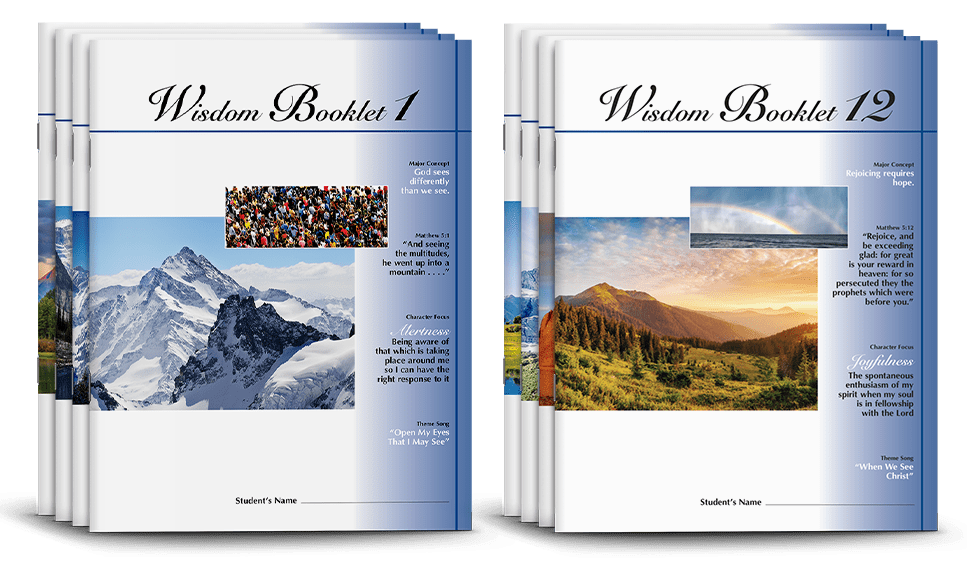
When I returned home from IBLP’s headquarters, the school year was starting and my responsibilities went from working a 9-5 job to starting 8th grade. My brothers and I were homeschooled by our parents, and though we joined competitive speech and debate clubs once I entered high school, we otherwise had very few extracurriculars and teachers. Each summer mom collected stacks of textbooks and each fall she’d hand them to us and say, “Here’s your customized curriculum!” My stack of books usually consisted of Saxon Math textbooks, biographies of important historic figures, creationist science textbooks, booklets on Language Arts by IBLP, and of course, IBLP’s Wisdom Booklets, which have sections for each school subject with an (often unhelpful) Biblical spin on everything.
For a couple years I attended a science class that met once a week at a friend’s house taught by her mom. I remember dissecting defrosted corpses of a worm, a fish, and a frog in her kitchen, and hating every pungent second. I had 3 peers in the class, and the stay-at-home-mom who was our teacher didn’t have a background in science, but it was still probably the most technical class I took up until I graduated.
I struggled the most in math. It’s hard to learn without being able to ask a book questions, and it’s really difficult to Google word-problems. My mom didn’t know how to help me, and my dad worked 10-12 hours a day and didn’t have the emotional bandwidth to teach when he got home from work. I begged for a math tutor, especially closer to high school graduation when I planned to take the SAT, but mom wasn’t willing to pay anyone more than $10 an hour to tutor me, which meant that anyone we found to help wasn’t professional. Mostly I did math on my own, and several years in a row I repeated the same book because I just couldn’t grasp pre-algebra.
I don’t remember ever learning geography, social studies, or reading history from a traditional textbook. I did like to read, and creative writing was a favorite pastime of mine, so, educationally speaking, those were my best subjects.
I felt very alone in my education. My brothers and I had limited accountability from our parents or any teachers we had, and never took any tests by which to measure our comprehension. In fact, the first test I ever took was the SAT. Because of this, I had no idea how grades worked, as grades were only discussed when mom sent quarterly report cards to the umbrella school we homeschooled beneath. The process was like this:
“How do you think you did on English this quarter?” Mom would ask, her fingers perched over the keyboard at her desk.
“I think I did alright,” I would tell her.
“Great! I’ll give you an E for Excellent,” and she’d type that in. “How do you think you did on math?”
“Honestly not very good. It’s really hard,” I’d tell her what she already knew. “I would give myself a U for Unsatisfactory.”
“Oh, well that’s not going to look good on your report. And I’m sure you’re doing better than you think. I’ll just put in a G for Good.” And she’d type that in and send it off. And just like that, math was going just fine for me…on paper.
We’d start our studies in the mornings and then were free to do what we wanted in the afternoons. All I’d have to do was say, “Okay mom, I finished everything for today,” and she’d say, “great!” and then I was free. Or at least as free as you can be at home with nowhere to go.
Does that mean that I always did my studies properly before telling mom I was finished? No. But the neglect of my schoolwork only lasted until I realized that if my parents weren’t keeping me accountable, then my education was in my own hands. I was probably 11 when this occurred to me. I went from seeing what I could get away with to worrying about what job I’d be able to get someday if I was never able to comprehend my books.
In high school Liam didn’t actually open his math book for months and my parents didn’t find out about it until he admitted it, probably after having an oh-shit realization similar to mine about the possibility of graduating illiterate.
It was never a matter of if we would graduate: I knew we would. It was easy to write “Excellent” on report cards. But I worried what would become of me if I didn’t have anything to show for my diploma.
A continuing education once I graduated wasn’t on my parents’ minds at all. In fact, when I told them I wanted to go to community college, they were disappointed. In their minds, my destiny was to get married, have kids, and be a stay-at-home mom to homeschool them. (Yes, homeschool them with my “superior” education.)
A huge element of my education starting around fifth grade was Wisdom Booklet class, consisting of 5-6 homeschool IBLP families banding together to educate through IBLP’s curriculum. Some of this I enjoyed, especially the social elements. The other girls were my age and we liked spending time together, although our interactions were heavily monitored. It was nice to be interacting with people of all ages, from everyone’s tiny young siblings to other moms and sometimes dads. Some of the moms exerted such authority during any interaction with them that they scared me. Others were warm toward me in motherly ways that I didn’t usually receive from my own mom.
The moms would split up the sections of each Wisdom Booklet and take turns teaching “classes” every week, sometimes assigning kids to teach sections too. It always stressed me out when I had to teach a section to everyone else because I felt like I had to be creative to make it interesting or come up with an activity, but given how I was mostly self-taught anyway, that wasn’t exactly foreign to me.
All of this aside, the value of the Wisdom Booklets themselves was iffy. There was a hymn on the back of each booklet (and about 50 booklets total) and we’d learn to sing each hymn. Several kids played the piano, so we always had an accompanist. Each booklet focused on a verse from Matthew 5, the Sermon on the Mount, so over time we memorized most of that chapter. The contents of each verse dictated the subject matter of that booklet, and given that any verse in the bible is a sentence or two, this made the booklets dig deep for content. We learned to recite the Greek alphabet because some of the Bible was written in Greek, and the language section of each booklet (Greek–very applicable in life!) would make an effort to interpret what the Bible said in the original text. There were sections for history, language arts, “math”, law, and science, but all of it was extremely Bible-focused. Beyond some of the history, I’m not sure how accurate any of it was. I have no idea who wrote the curriculum and what their credentials are. My family spent years attending Wisdom Booklet class and centering our homeschool social activities around this small group.
My last years in high school were tumultuous, to put it lightly. I was disciplined and motivated, but my home life was so strained that I didn’t have any emotional bandwidth left for joy found in learning. I was living in a constant state of crisis and disassociation, and would spend long periods of time emotionally “shut down” in order to cope, a problem I still deal with over a decade later.
The best parts of my life at that point were my few friendships and involvement in competitive speech and debate. In public speaking I found a strength that I could pour my whole self into. It was one of the only things that I was mostly in control of: I could choose the topics of my speeches, and into each speech I funneled my opinions and creativity. Additionally, I did well in competition from the beginning, so that immediate gratification and the challenge of beating my peers kept me busy.
There were problems down the line that come along with parents wearing the hats of both parent and teacher, as well as with what happens when you turn something educational into a competition with the ultimate stake being your parents’ financial investment in it. If I ever expressed feeling that pressures of competition were impacting my mental health, my mom would complain that if I wasn’t competing to win, then she was wasting her money.
My brothers and I were often reminded of the sacrifice that my mom made to homeschool us. She set aside her career and dreams to homeschool because she “didn’t want us to have the horrible experience” that she did in public and private schools as a kid. She and my dad both had terrible school experiences and they wanted better for us. Furthermore, they were convinced that God commanded parents to protect their children from the world by homeschooling them. According to my parents and leaders like Bill Gothard, there really was no other choice. Despite this, my parents liked to remind us of the sacrifices that they made to survive on one income and pay for our educations frequently.
To complicate things, during my senior year of high school, mom began threatening to just give up and send me to public school. This threat sent me spiraling because I knew that there was no way I could integrate into a school mid-year and still graduate high school on time. I was convinced that if I entered school I would be put back several grades due to my lack of overall comprehension, and by then I was desperate to graduate so I could move out.
I just wanted peace. To live in a home where I wasn’t constantly spied on, criticized, lectured, and disappointing to people. It is true that teenagers are hormonal, opinionated, and difficult to raise, and each one is different. I know that Liam and Weston and I have all been very different children to raise, and I was my parents’ only daughter, so I was a guinea pig right along with Liam. For my mom, who is very feminine, to raise a stubborn tomboy was extremely challenging for her.
I don’t have children and I’m sure I’ll “understand” better when I do, as people like to tell me. But I do believe that a child’s experiences should be validated even if their feelings and current perception of reality won’t last forever. It’s wrong for parents to tell their children to “just grow up already” in order for their opinions and feelings to be considered important. Childhood is a huge portion of a person’s life, and those formative years are especially significant. To be treated with such inferiority during a time when a person’s brain is still developing is damaging and has permanent side affects. I still discuss my childhood in therapy a decade later, and I know that I am not alone in doing so.
Well, I did graduate high school, I did work my ass off to do so, and I do think that my education was still deplorable compared to many of my peers, especially those fortunate enough to be put in charter school classes with teachers who were qualified to teach their subjects.
Did I survive? Yes. Was adulthood a complete culture shock that took years to adjust to? Also yes. Will I be homeschooling my own children? Absolutely not.
 Leona Left Fundamentalism
Leave a comment