I was at lunch with my godmother a month or so after returning home from headquarters, right as the school year was beginning. Teenage life felt limiting and bland compared to what felt like my glory days as a staff member. I missed it. I’d cried the hardest in my life after it sunk in that I wouldn’t be returning until at least the next summer, and by then it would be different: the people who had become my family might not still be there, and in the meantime, it was back to my small, unimportant 13-year-old life.
Funny thing, my godmother had been in Chicago during the time that Liam and I were at HQ and asked to visit to meet Mr. Gothard. We invited her to have lunch on campus. When my godmother arrived, I immediately noticed her capris, worn loosely with a blouse. IBLP’s dress code was strict: girls wore skirts or dresses, and boys wore pants with polo shirts, button-downs, or t-shirts that had IBLP-related program logos, but that didn’t apply to afternoon visitors who didn’t know any better. I brushed it aside as unimportant, but I noticed her looking around self-consciously as she stood in line at the buffet.
“Should I have worn a skirt?” She whispered nervously to me.
“Oh, no, it’s not a big deal. Don’t worry about it,” I reassured.
Bill spoke at lunch as usual and afterward my godmother went up to him with me and Liam and greeted Bill. “It’s wonderful to meet you!”
“This is a delight,” Bill said in his trademark voice, slow, intentional, and impossible to burn out of your brain after you’ve listened to so many hours of him.
“You know,” my godmother began, “my husband and I went to your Basic Seminar in the 80s and it was at that seminar that we were saved. So we have you to thank for bringing us to the Lord!”
“How wonderful,” Bill smiled, then looked to Liam and me. “Liam and Leona are such great young people, you’re very blessed to have them in your family.”
“Oh, well, believe me,” she pulled my shoulder into her, “I know.” Then they smiled at each other for a moment before I offered to give her a tour around campus.
Now at lunch with her back home, my godmother had questions. I’d just spent an hour gushing over how wonderful HQ had been and how badly I wanted to go back.
“But don’t you think it’s a bit weird,” she leaned toward me over her plate, “that all the girls have to wear skirts?”
“Well, no,” I shrugged. “That’s just our dress code.”
“Exactly, and why do you have a dress code? You’re just volunteering.”
“Well, it’s so that our bodies aren’t distracting to the guys.”
She frowned at me. “Yes, but weren’t you telling me that when you played volleyball there on Saturdays that it was hard for the girls to play in skirts and it put you at a disadvantage?”
“Yeah, that was kind of annoying, but we just wore pants underneath so that if we kicked our skirts up or dove for the ball, we were still modest.”
She seemed to be trying to drive home a point. “Do you think that the capris I wore when I visited were immodest and distracting?”
“Well…I guess not.”
She paused and looked deep into my eyes. “Leona, have you ever considered that IBLP is kind of…culty?”
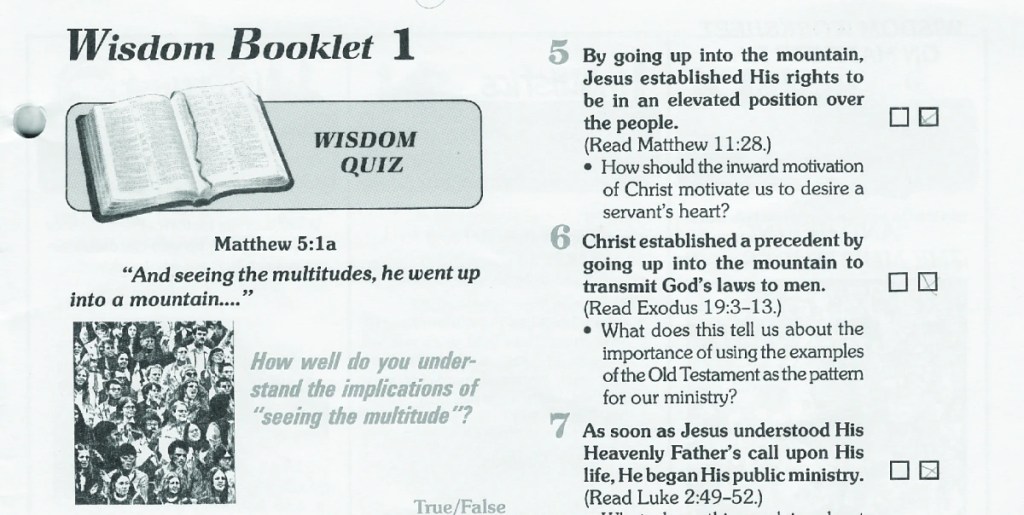
I’d been briefed on this before. ATI’s Wisdom Booklet’s explained that IBLP was not a cult, but that people might try to frame it as one. “Oh, no!” I pushed back. “It’s definitely not a cult… I mean, skirts aren’t a big deal. We have to wear skirts at the ATI conferences too. It’s just the uniform.”
“Hmm,” my godmother frowned and nodded.
*****
At the first ATI conference my family attended when I was 8, I wore a khaki skirt my mom had sewn for me because she couldn’t find anything suitable at the store. My mom has always been an amazing seamstress, and I loved the skirts she made over the years as part of my conference uniform. But I noticed others in my small groups who weren’t as lucky. As someone who also knows how to sew, it’s easy to spot a handmade skirt, even one that is made with skill. Over the years I’ve seen a lot of terrible navy blue or khaki tubes bunched at the waist on girls and passed off as “skirts.” In hindsight, these might have been even more distracting than a pair of normal pants.
Lucky for us staff members, jean skirts were acceptable for girls to wear at HQ, which were much easier to find in stores. Perhaps being introduced to the conference uniform from such a young age made the HQ dress code easier to adapt to. I was just glad I didn’t have to wear them at home too; some of my ATI friends weren’t allowed to wear pants at all, ever.
Why did IBLP care so much about what girls wore? Bill Gothard would cite Bible verses like 1 Timothy 2:9: “Likewise also that women should adorn themselves in respectable apparel, with modesty and self-control, not with braided hair and gold or pearls or costly attire.”
And also Deuteronomy 22:5: “A woman must not wear men’s clothing, nor a man wear women’s clothing, for the Lord your God detests anyone who does this.”
Pants were what men wore, so it was wrong for a woman to wear them. That was that. Skirts and dresses only, and make sure they’re not too short or too tight, because let’s not forget Matthew 5:28: “But I tell you that anyone who looks at a woman lustfully has already committed adultery with her in his heart,” and the Bible clearly says adultery is wrong in verses like Exodus 20:14: “Thou shalt not commit adultery.”
This string of verses brought Bill (and other Christian leaders) to the conclusion that women were responsible for ensuring that men didn’t “stumble,” which was a palatable way of saying what my mom explained to me when I was little: “Boys will undress you in their mind if they see you wear things that show off your body, and it’s a sin for them to do that, but boys are weak and can’t help it, so we need to prevent that from happening by hiding our bodies with the clothes we wear.”
Modesty was hiding our bodies to keep boys from sinning, and it was a lesson taught to girls so young that it was easy to muddle a few technical details and conclude that it was our bodies that were sinful and needed to be hidden.
This by itself is a complicated issue that hurts and controls women, but it had me asking big questions too. Why is the burden on girls to prevent boys from sinning? If girls are responsible for their own sins, why can’t boys be responsible for theirs?
“Because,” I was told again and again, “boys are weak and don’t have the kind of self-control that girls have. Men lust in a way that women just can’t understand. They are sexual in nature. Women are emotional in nature.” It felt so heavy and unfair to be responsible for the thoughts of the boys around me as well as for the boys’ dads around me.
It’s hard to put into words how much the girls dress code actually affected us daily. We were always vigilant to protect the eyes of our brothers in Christ. I remember on a Saturday during volley ball, one of the staff members was wearing a new skirt she had proudly thrifted. It tied at the side, and I noticed that afternoon that it had untied without her noticing and was beginning to slip down. I rushed over and pulled it up, whispering that it had come undone, and while I hadn’t meant to scold her, she immediately turned red and began to cry, blubbering between sobs, “Did any boys see? I don’t want th-them to…s-stumble!” I reassured her that it had only just happened and I didn’t think anyone had noticed, but she continued to cry, any personal feelings of embarrassment eclipsed by fear that she might have caused a brother to sin because of her body.
I heard a story from Amy about a prayer meeting she’d attended as part of a girls’ Journey to the Heart. All the girls had been on their knees in fervent prayer, with Bill praying a blessing over them. After everyone said “amen” and were getting up off the floor, one girl stood up while accidentally stepping on part of her skirt, and the loose elastic tying it to her waist stretched so that she stood up with only her underwear still on. Mortified, she pulled on her skirt as fast as she could, but she left the room in a puddle of tears.
One time, Amy and I visited Liam in HQ’s IT department and Aaron, one of Liam’s coworkers, asked Amy not to wear flipflops around him anymore so he “wouldn’t stumble.” I remember Amy commenting to me later, “Wow, I really appreciate him telling me how I could help him.” I remember scrunching my nose nauseated at the thought of Aaron–in his late-twenties–looking at Amy’s 14-year-old sandaled feet thinking, “I can’t stand this. She needs to wear close-toed shoes before I lust after her toes!”
I can’t help but question whether his request to Amy was really to prevent him from lusting after her feet, or if it was actually him exercising his male power over the female staff members who felt compelled to accommodate him to “protect him from himself.” Reflecting upon this now, I realize that IBLPs normalization of men having no self-control was a form of weaponized incompetence that worked to shield men from being responsible for inappropriate actions against women, including harassment, abuse, and even rape.
On that subject, Bill Gothard’s teachings were very specific on rape. If a woman was raped and she didn’t cry out for help while it happened, she was considered responsible along with the rapist, and needed to ask for God’s forgiveness. It wouldn’t even be going too far to ask her questions like, “What was she wearing? Did she cause this man to stumble and was that why she was raped?”
*****
People outside of IBLP HQ knew we were different, but not in that alluring way that Bill idealized. One time, Amy, myself, my house leader Jen, and Jen’s friend, Dave, (somehow sanctioned to be with us) were off campus at a Burger King. We sat at a table eating our burgers, minding our own business, when we noticed a group of guys at another table watching us. We wore our our usual uniforms.
Why are they staring at us? I remember thinking. It was the first time it registered to me that people thought of us as those people in the same way that people joked about Jehovah’s Witnesses or Mormons.
We finished our burgers and got into Dave’s little car and began driving away. A moment later Amy asked, “Isn’t that the same people who were staring at us?” She was looking behind at the car tailing ours.
Dave glanced in the rearview mirror and nodded. “Yeup… Don’t worry though, we’ll lose ’em.”
We didn’t lose ’em. We drove around, turned right three times, and every time we looked behind us we’d confirm over and over again, “Yep, they’re following us. They’re onto us.”
What they expected to do once they followed us to our destination I didn’t know, but none of us wanted to risk bringing strangers to HQ.
“I have an idea,” Dave grinned. Five minutes later, Amy and I peered out our windows suspiciously. “It’s getting dark.”
“Where are we?”
“Hey…is this a…graveyard?”
Jen laughed and clapped her hands. “We scared them!” Dave looked in his rearview mirror for a couple of moments before confirming, “We creeped them out! They left us once they saw where we brought ’em.”
Jen liked Dave and she was well into her 20s, so it wasn’t such a crazy thing for Amy and I to cross our fingers that Dave might call Jen’s dad and ask for permission to court her. One time when Jen and Dave were in our house’s living room, I played “Here comes the bride” on the piano and had to apologize to Jen later, because it had made her turn bright red. People at HQ said that girls on staff often stayed at HQ for years and years, only leaving “in a white dress or a coffin.”
Technically Jen was my house leader and had full authority over me, but she acted as more of a friend. Sometimes I borrowed her blouses because she had a closet full of HQ-appropriate clothes and I had only packed the handful that I owned. I wasn’t intimidated by her and she never asked me to do anything unreasonable or accused me of being rebellious. But I know of house leaders who took advantage of their power.
One of the newer staff, Casey, had driven down from Canada to volunteer, and had been put in a house whose leader required everyone to wake up at 5AM each morning to do a full hour of Bible devotion before getting ready for the day. Casey complained to me that she didn’t like being told how to spend time with God. Quiet time was private and should be chosen instead of forced. But if you didn’t listen to your house leader, they could speak to their leader and that leader could speak to theirs, up and up the chain of command until word got back to Mr. Gothard that you had a rebellious spirit. A rebellious spirit was a common diagnosis if you were at the bottom of the chain of command, almost as chronic as hysteria in the 1800s. You could have a rebellious spirit if you listened to any kind of music that wasn’t hymns or classical. You could have a rebellious spirit if you were a girl who someone with authority over you thought dressed too boyishly, or if your parents reported that you misbehaved for any reason. Often, innocent people were diagnosed with a rebellious spirit, but disagreeing only made things worse.
I highly doubt that Casey actually had a rebellious spirit–she was one of the sweetest girls on staff. But she’d often tell me that her house leader had problems with her. We didn’t say it out loud, but we both looked at each other and thought, the real problem is the house leader.
Casey had a little sister who also wanted to come to HQ and volunteer. She had tried to cross the Canadian Border, but had been sent back because they were suspicious about her–a minor–coming to volunteer at a religious organization. Bill told the staff what was going on as if tragedy had struck IBLP, concluding forlornly that we were being persecuted. We all promised to pray for a miracle.
A day or so later, we got word that she’d re-attempted to come to the US, but was put on a watch list and again sent back to Canada. Apparently, the Canadian Border had called IBLP and asked what the staff were paid. The staff member on the phone had answered, “Just a fifty dollar stipend,” which was the worst thing they could have said, because $50 a week for 40 hours of labor was illegal.
“But it’s just volunteer work!” We all wailed when we heard the news. “This isn’t a sweat shop! The $50 stipend is to pay for things like toiletries. All of our needs are taken care of here!” We all said to each other, but it was no use, the Canadian Border couldn’t hear us, wouldn’t listen. And they wouldn’t let Casey’s sister through.
Back then I felt sad for her. But now I look back and think, “Wow, good for the Canadian Border. They suspected that IBLP was a cult and were trying to protect a minor from abuse and exploitation. And they were right.”
IBLP really pushed the idea of instilling blind obedience in children and absolute authority on parents. One year at the ATI conference, I was having a conversation with Carter–a friend I’d grown up with–and mid-sentence he cut himself off and without explaining walked over to his mom a few paces away. My mom told me later that she had been talking with his mom who’d said, “Hey, watch this,” and whistled. That’s when Carter had immediately walked over to her, leaving me behind in confusion. My mom had ooh’d and ahh’d at this instant obedience, but I’m glad she never practiced anything like that on my brothers and I. I don’t think that exercising power like that should be a party trick. We aren’t dogs, and this isn’t The Sound of Music.
*****
On Sundays everyone on staff piled into the rickety 15-passenger vans that Journey to the Heart used to drive to the North Woods and we’d attend the Baptist church that Bill frequented. Sometimes after church we would all go to Boston Market for lunch, which was Bill’s favorite. As an foodie I cringe at the memory, but looking back, I should have known that someone who tells his chef not to cook with garlic anymore to avoid the risk of a bad impression by crime of garlic-breath would prefer Boston Market.
On the weekend evenings, we sometimes had staff meetings where one of the MGA’s (Mr. Gothard’s Assistants) read a book out loud, like we were all children sitting around a parent reading us a bedtime story. David Waller and Robert Staddon were the MGAs at the time. I can’t remember what book we read, but I remember that David wouldn’t even acknowledge a character in the book drinking coffee, and automatically switched the words “coffee cup” to “hot chocolate cup” mid-sentence. I remember the eruption of giggles pass over the room and David struggling to keep a straight face. It was no secret that David had a “conviction” against coffee due to the caffeine, and wouldn’t even touch something containing it. Meanwhile, Robert Staddon was known for his enjoyment of Mountain Dew, a caffeine-laden drink.
I heard a story from Amy over the phone that the MGAs were doing some chores around the campus kitchen and David was taking out the recycles. Robert called to him across the kitchen, “Hey, can you add this to the bag before you take it out?” and pointed to an empty can of Mountain Dew on the counter. David refused.
“Really?” Robert was amazed.
“Please don’t make me touch it!” David responded despairingly. “You know about my conviction!”
*****
Leading up to my departure from HQ, Bill kept prodding me to come to his office to spend an evening with him. One evening he called me. I can’t believe I actually had his contact in my flip phone.
“Come to my office so I can give you a blessing with your parents on the phone,” he encouraged me. There was no saying no to that. Anxiously I entered his office and sank into a chair dwarfed by the enormous desk he sat behind. He had an old-fashioned telephone on his desk that had the curly cord attached. His office was decadent and rich-feeling, and the carpet was red.
Suddenly my parents were on speaker and Bill had smeared my forehead with olive oil from a tiny little bottle, like I was Simba. I remember hearing my parents weeping on the other end of the line as Bill prayed some vague blessing over me, and I remember sitting there on my knees on the floor, feigning sincerity, waiting for it to be over, and feeling awkward and guilty that I wasn’t more touched by it all. Liam was there and at least he wasn’t crying either.
*****
I have this memory of descending from the top of the airport escalator after arriving in my home state and spotting my mom waving to me. When she pulled me into a hug she began to cry, whispering how much she had missed me, and I remember it occurring to me that I hadn’t missed home at all.
I’d loved being away–it had been my first chance in my little life to figure out who I was apart from who my parents told me I should be. I cried for weeks over the loss of the life I’d said goodbye to back in the Chicago airport. I called Amy often and she updated me on the HQ news and gossip.
Liam returned at the end of summer and homeschool life returned him to his teenage self, shrinking him several sizes to fit into the mold of my parents’ firstborn son, still young enough to ground if he misbehaved. I shrank too. I wore pants–shorts, even!–and secretly listened to music on youtube and got yelled at when I was caught. Then, when school began again, I studied the Wisdom Booklets that I’d been packing and shipping to families all summer.
 Leona Left Fundamentalism
Leave a comment